“There is no place like home.”
This is how the United Nations begins its compelling text dedicated to the International Day for Disaster Risk Reduction.
Home is where we find warmth, safety, and comfort. In an effort to draw a parallel between our planet and the place we call home, the author uses the word home. Yet this is more than a metaphor. It reflects a fundamental reality: Earth is, quite literally, our home.
But to what extent does this understanding apply to our own country? Do we truly treat it as our home? Have we taken the necessary measures to protect our local communities?
The International Day for Disaster Risk Reduction was established in 1989 following an initiative by the United Nations General Assembly, with the aim of promoting a global culture of disaster prevention, risk awareness, and preparedness.
According to the UN publication, during the Third United Nations World Conference on Disaster Risk Reduction, held in Sendai, Japan, in 2015, the international community emphatically reaffirmed the importance of protecting people severely affected by disasters and preventing sudden catastrophic events that displace millions of people every year.
Prevention must be grounded primarily in strengthening resilience, starting at the local level.
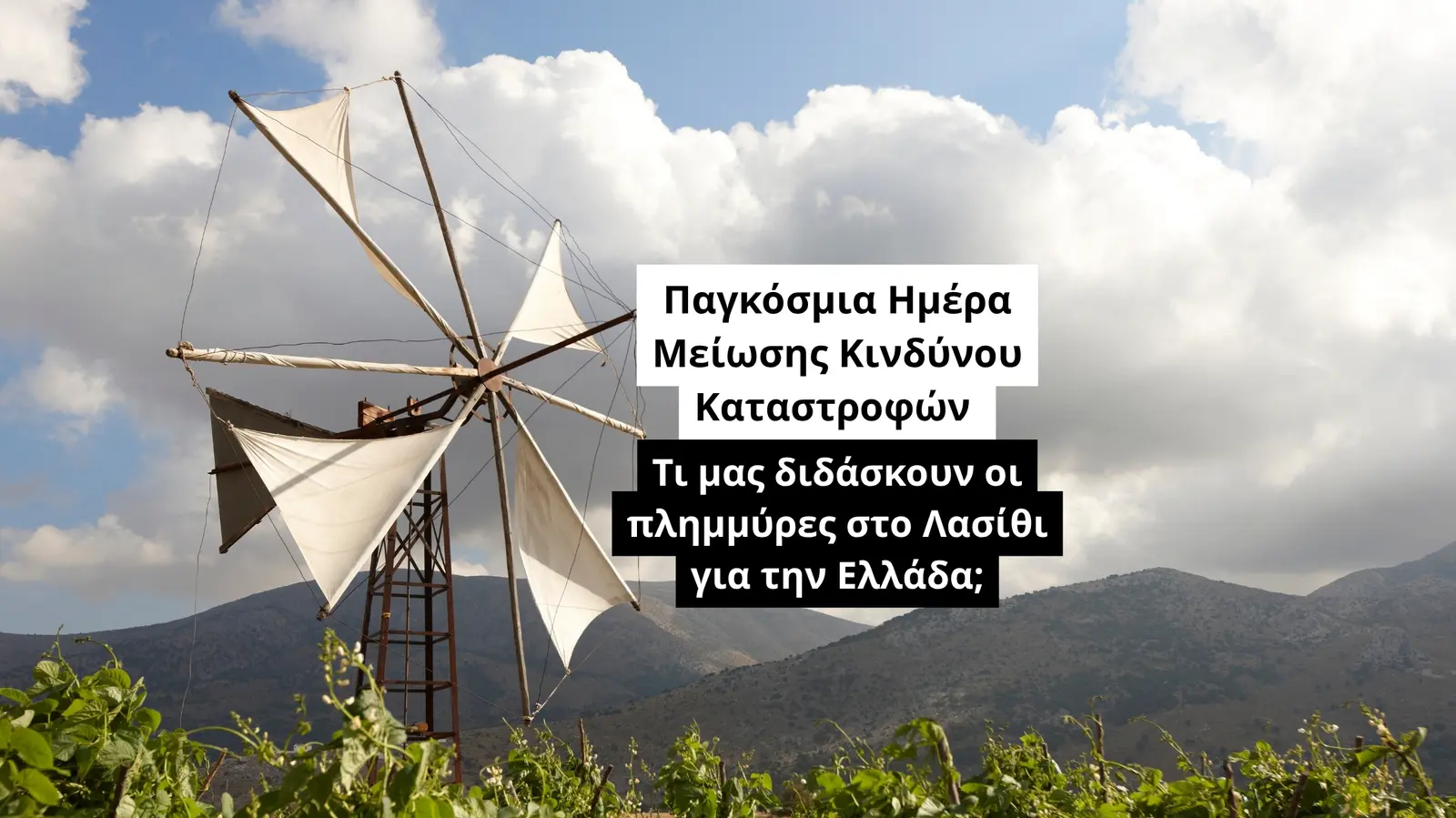
The Devastation of the Lasithi Plateau
Flooded agricultural fields, farmers' livelihoods under threat, and landscapes reminiscent of submerged rice paddies in Asia. Almost surreal scenes from the Lasithi Plateau, a region that represents a true treasure of Greek agriculture and livestock farming.
Could anything have been done to prevent this devastation?
Experts argue that preventive action was possible, while local residents continue to protest and demand accountability.
The recent floods in the Lasithi Plateau are a stark example of how natural disasters can devastate communities, threaten local economies, and undermine social stability. Such events demand a response, but not one limited to emergency management.
Not simply through compensation payments, but through the development and implementation of meaningful, long-term solutions.
As early as 2021, a scientific study by diaNEOsis, entitled “Integrating Climate Change into the Transformation of Greece's Development Model”, highlighted the impacts of extreme weather events on agricultural production and the urgent need to adapt infrastructure to changing climatic conditions.
Five years later, the devastation of the Lasithi Plateau once again brings the issue of prevention to the forefront, raising two fundamental questions:
When will prevention finally take precedence over emergency response?
And when will the extensive, rigorous scientific research already being conducted be translated into meaningful policies and concrete solutions?